
The red flags in the forests of Bastar or Dantewada, the ambushes, the landmine blasts, the young men and women who disappeared into the hills carrying rifles. It started with a real place and a real fight over land.
May 1967. A small village called Naxalbari in the foothills of the Himalayas in West Bengal. Peasants, mostly tribals and landless labourers, rose up against landlords. They wanted the land they tilled. Charu Majumdar, Kanu Sanyal, Jangal Santhal — these were the names that came out of it. Inspired by Mao, they believed only armed struggle would change anything. The police fired, people died, and the idea spread like fire. Within a couple of years the CPI(ML) was born. Students from Calcutta colleges left their books and joined. “Class annihilation” became the slogan. Landlords and policemen were killed. It was brutal, idealistic, and short-lived in its first form. By 1972 most of the early leaders were dead or in jail.
But the idea didn’t die. It moved. In the 1980s it took root among tribals in Andhra, Bihar, Odisha, and what later became Chhattisgarh and Jharkhand. People’s War Group in the south, Maoist Communist Centre in the east. In 2004 they merged and became CPI (Maoist). That was the high point. At one stage nearly 180 districts felt the heat. Security forces lost hundreds of men. Civilians got caught in the middle. Mining companies, contractors, local politicians — everyone had a story. Manmohan Singh called it the biggest internal security threat. The Red Corridor was real.
Fast forward to now. The guns have largely gone quiet. Official numbers show violence down by almost 90 percent from the peak years. Affected districts have shrunk from over a hundred to a handful. Thousands of cadres have surrendered. The big leaders are mostly gone — killed, captured, or old. The government says the armed phase is breathing its last. Home Ministry data and ground reports from Chhattisgarh and Jharkhand back that claim.
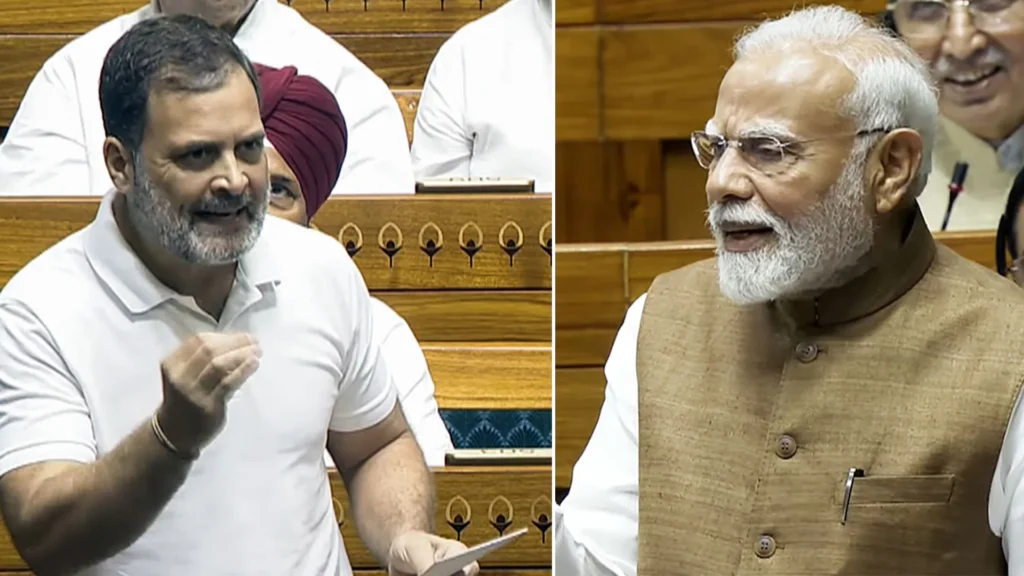
So where does the Left go from here? That is the real story of the last few years. The armed wing is weakened, but the ideas never lived only in the forests. From the beginning there was an urban side — students, professors, lawyers, writers, activists who saw the Naxals as fighters for the oppressed. Some gave open support, some gave quiet sympathy, some simply refused to call them terrorists. In the 2010s the phrase “urban Naxal” started getting used. After the Bhima Koregaon arrests it became common. Now the language has shifted again. In his Independence Day speech in 2026, the Prime Minister spoke of “dimagi Naxals” — the Naxals of the mind. He said the armed ones in the jungles have been largely dealt with, but those who carry the same thinking in cities and institutions are still looking for openings. Identify them, isolate them, bring the youth into the mainstream — that was the message.
The reaction was immediate. Some opposition leaders said the term is just a way to brand any critic. P. Chidambaram even said he was proud to be one. Social media accounts calling themselves Dimagi Naxal Party popped up with memes and slogans about thinking and resisting. On the other side, supporters of the government argue that for years an entire ecosystem — in universities, NGOs, parts of the media and legal circles — treated the Maoist project with soft gloves while the security forces paid the price. They point to old party documents that talked about using intellectuals and mass organisations in cities as part of the larger strategy.
This is where the evolution of the Indian Left becomes interesting. The parliamentary Left — CPI, CPI(M) — once ruled West Bengal for 34 years, Tripura for decades, and still held Kerala until recently. They took the democratic path. The Naxal line rejected that path completely. One side contested elections and ran governments; the other tried to smash the state. Over time both have shrunk. The mainstream Left is a shadow of what it was in the 1980s. The armed Left is on its last legs. What remains is the argument over ideas — land, forests, mining, development, who speaks for the Adivasi, who decides what justice looks like.
You can walk through Naxalbari today and see BJP flags. Young people there talk about jobs and roads more than revolution. In the old Red Corridor districts, new roads, schools, and mobile towers have arrived along with the security camps. Whether that heals the deeper wounds of land and dignity is still an open question. Poverty and alienation did not invent themselves. But the method of answering them with the gun has clearly failed.
The debate over “dimagi Naxal” is really a debate about the limits of dissent. Criticism of the state is not the same as romanticising violence against it. Questioning a mining project is not the same as justifying the killing of a jawan. Yet in a democracy the line between hard criticism and ideological sympathy can get blurred, and both sides have reasons to blur it further. One side sees a lingering threat that needs to be named. The other sees a convenient label that can be stretched to silence uncomfortable voices.
Sixty years after that first clash in a small Bengal village, the guns are quieter. The argument over what those years meant is louder than ever. That, more than anything, shows how the Left in India has changed — from the fields and forests into the realm of words, institutions, and competing stories about the country itself.
Sources:
Deccan Herald, India Today, Ministry of Home Affairs data reports, Outlook India, Business Standard, Open Magazine, News18, The Hindu, PolSci Institute analysis, Aeon Essays, Swarajya, CNN reporting on the insurgency, and contemporaneous coverage of the 1967 uprising and the 2004 CPI (Maoist) merger.
@Rohit Manral